I’ve talked to a number of folks in the past few months who do similar work to me and who I think have “good content” online, and when I asked them about their content strategies, most of them went “Uh, well…”
And honestly, same. Why is it that I have made literally dozens of content strategies for brands and I have never had one for myself?
No matter how much I told clients “you know, it would really help to have some strategy behind this…” the most strategy I ever had for my own content was something like “making this content will bring me new clients (i hope)” which sounds a lotttt like “making this content is going to bring us tons of new customers (we hope)” so…
pot, meet kettle 👋
It’s easier to dish out advice than to take it, okay?
Okay.
So I finally sat down and made a quick-and-dirty content strategy for myself.
These are the exact steps I used, so it’s not fancy and it almost certainly could have some improvements, but it is fast and includes the most effective pieces from the strategies I build for clients. If you’re in the same boat I was in, feel free to use this process for yourself.
- Who I think this would work for: solos and freelancers, small businesses, founders who are managing marketing for startups, and potentially even brands with very small teams who just need something scrappy. Also teams who want to do more employee advocacy branding could probably use a simplified version of this for their employees!
- How long is this gonna take? It really did take me four hours, YMMV. I split it up over several days, so the whole thing was done in about a week and a half.
- What do I need? Pen & paper, some kind of database or table (I used Notion), some sense of what you want your content to do for you
Also, I know this is going to have a LOT of detail, so instead of leaving your heads swimming with no concrete examples or leaving your heads swimming trying to make sense of my actual messy ideas, I’m going to use this (somewhat fictitious) example:
In this example, I’m going to be selling a new workshop helping freelancers and startups build a quick-and-dirty content strategy in 4 hours (work with me here, okay? 😂), so my strategy examples will ladder up to that goal.
Ok, onward:
1. Figure out where you’re going (30 mins)
You can’t (well, shouldn’t) take a hike without having some kind of destination or end-point in mind. Making content is the same. Sending out random acts of content (or as Brandon Marcus says, “confetti content“) with no real sense of how — or if — it helps you with your goals (let alone your audience with theirs!) is the equivalent of wandering around in a forest assuming you’ll find the summit eventually.
This matrix is how you figure out what the heck you’re trying to do with your hike, I mean, with your content.
It’s a super simple version of the foundational questions I use with clients when I build content strategies for them. In short, you’re answering the classic “Ws”:
- Who needs to know about me? Who’s the audience that I can help (or our product helps)?
- What are my core ideas / POVs? What do I believe about my work / industry / processes / etc. that set me apart, that my clients should know? What ideas shape the way I make decisions and do work for clients?
- Where does my audience hang out?
- Why do these ideas matter (to my audience and to me)?
I recommend drawing this out on a sheet of paper, because doing early brainstorming with paper and pen does cool things with your brain that I won’t take the time to dive into here (just trust me, though).
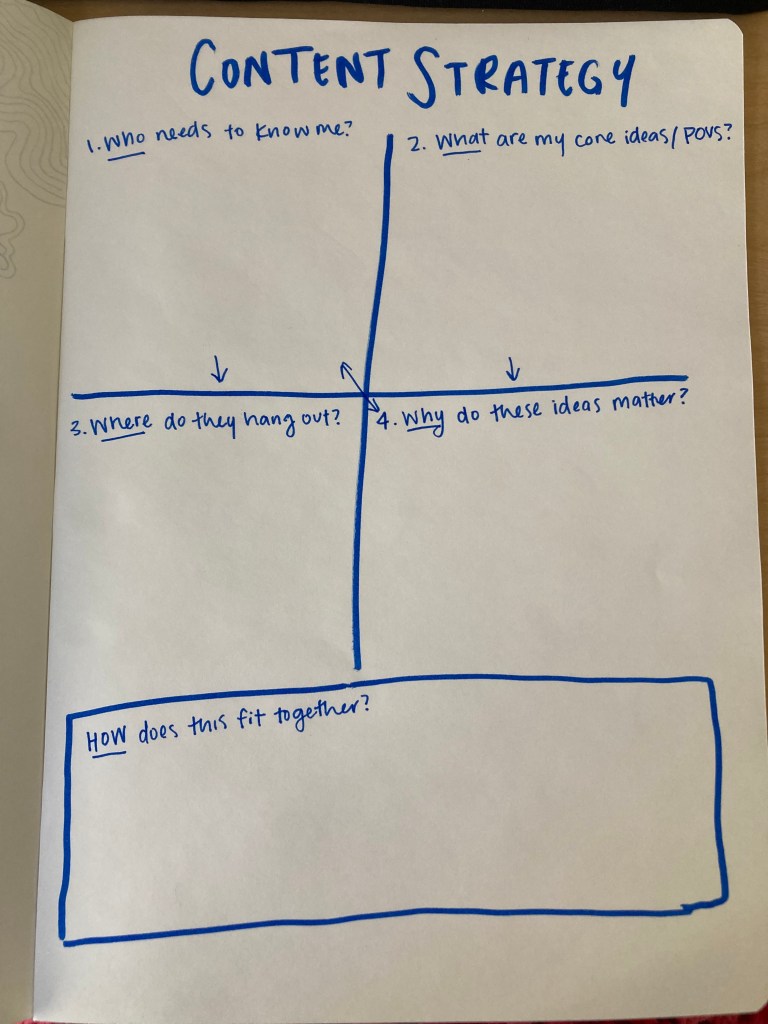
The little arrows I’ve drawn on my matrix are just reminding me how these answers are going to connect.
You can start in either of the first two quadrants, whichever feels easier. They should inform each other — your core ideas about your work likely helps narrow down who needs to know you. Then you can flesh out why those ideas matter to that audience and where to share them.
Using our example, I might determine the following:
> Who: core audiences might be solopreneurs or startup founders who know content can help them, but don’t know what to talk about or where to start
> What: the longer you spend on a content strategy, the less likely you are to implement it; writing more content can be counterproductive if it’s not the RIGHT content, etc. (I don’t know if I actually believe those things, but they would be good spiky POVs)
> Where: probably LinkedIn, maybe some Slack communities or YouTube
> Why: this audience probably doesn’t want to invest too much time or money into “building a content strategy” but they also might be losing traction and momentum by using a “throw spaghetti at the wall” method instead.
Then I added a box at the bottom for how those pieces fit together, where I’m starting to answer questions like:
- What content tactics and types are best going to match my ideas, channels, goals, and audience
- What distribution channels match the content and audience
- How I’m going to share those ideas based on what the audience needs
Side note: when I’m working with clients, I spend a lot more time first on the goals and the why in general, like, why does your content even need to exist?
- What’s it doing for your business?
- What’s it doing for your audience?
- What bigger business goals and objectives is content going to support?
Because my business is, well… mine, and I’ve spent a lot of time thinking about content and my business goals, I have this info in my head already.
But if you’re copying this for yourself and you don’t know why you’re making content, figure that out first. The matrix above can help!
2. Plan your route (2 hours)
Next step: fleshing out the steps from point A to point B. Also known as: connecting all the dots.
I made a table in Notion (you could use GDocs or Sheets) with the following columns. You’ll want to have a separate column for each audience / problem pair. It roughly correlates to the matrix (and expands on it) like so:
| Who’s the audience? | Pulled from quadrant 1 on my matrix |
| What’s their problem? | I pulled core problems from quadrant 4 on my matrix. Why my ideas matter is directly tied to what problems this audience is experiencing. So, what are those problems? This is a bit implicit in my head from the matrix, but now I’m making it explicit. |
| What’s the typical solution to this problem? | As it says. How do I see most people trying to solve this? |
| Big idea / core POV | From quadrant 2 of the matrix. In general, one or two of my “big ideas” or “core POVs” will correlate to how I recommend clients to solve this problem, usually counter to how folks often attempt to solve it. It’s my special sauce, so to speak. |
| Flesh out the idea | Here I make a bunch of notes or bullet points that go into more detail about what I see work, how I see things, why I believe this, etc. etc. |
| What’s the process? | Sketch out in bullet points how I’ve solved this problem for clients in line with my POV |
| What’s an example? Stories / illustrations | Jotting down real stories / examples from my own work or client work, or illustrations that demonstrate my process or my ideas. |
| What’s the result? Where do they want to be / where and how do they end up here? | Here I’m making notes on the transformation — what results do my clients get from my processes that are not achieved by the typical solutions. What’s different from where they started? How are their problems solved? |
I do this for each of the core problems I’ve outlined for each audience (2-3 core problems for 3 audiences, so I had seven of these total, with some overlap between them).
And if you’re sitting here thinking, holy crap, I thought this was gonna be quick, this is so much work, this step DID take me the longest. But! By the time I finished, it was becoming super clear to me exactly what I needed to be talking about a lot more.
And, better yet: now I can clearly see how all the things I might talk about fit together — how they relate to my readers’ needs, problems, things they’ve tried, things they want to try, things they’re not sure how to do but want to learn, etc. etc.
Here’s your example, following our theme:
| Who the audience is | solopreneurs or startup founders who want to do better content but don’t know where to start in sharing their ideas |
| What’s their problem? | throwing spaghetti at the wall and getting discouraged that their content isn’t getting traction or results |
| What’s the typical solution to this problem? | try to do more content, try new channels, use AI, write about different things, hire a ghostwriter, give up |
| Big idea / core POV | writing more content can be counterproductive if it’s not the RIGHT content |
| Flesh out the idea | not all visibility is useful — finding the right audience and giving truly valuable content = more important need to know WHAT to say not just saying something for the sake of being visible a simple strategy can be more useful than a long complicated one — finding a MVS (minimum viable strategy) that helps point your content toward your goals etc. etc. |
| What’s the process? | (bulleted points on the process i use to make a content strategy for this audience) |
| What’s an example? Stories / illustrations | (examples of how it’s worked for me or others) |
| What’s the result? Where do they want to be and how do they end up here? | confidence: knowing they are making content for the right audience and their goals save time: do less with more results etc. etc. |
3. Figure out your friends (30 mins)
If you’re REALLY pressed for time, I would say this step is optional, but it’s so helpful for me.
In my strategy doc, I made a heading for each of my three core audiences, and under each, I added a space for the following:
- Needs: What their core needs are (re: content)
- Fears: What they’re most afraid of (re: content). We don’t talk about emotion very much in B2B but it drives so much of our work and decision-making. Understanding what your audience is afraid of and trying to avoid is really important to figuring out, you know, how to help them avoid that. I use a couple of personality type frameworks to help me sort through core fears and apply them to content.
- Goals: What are they aiming for? Usually correlated with their needs — they need certain things to help them achieve these goals.
- Desires: What do they want? Not quite the same as goals, desires are more the emotion under the goal. For example, the goal might be to make content an effective channel or demonstrate ROI but the desire is to be seen as a valuable part of marketing, or earn their bosses’ trust, or do work their proud of without burning out, or etc. etc. etc.
Then, I write a few examples of people I actually know (or somewhat know) who I think fits this audience category. This is just to help me ground my content by feeling like I can write to a specific person.
An example, following our previous ones:
> Audience: solopreneurs or startup founders who want to do better content but don’t know where to start in sharing their ideas
> Needs: figuring out where to start, what to talk about, what will work. basic needs: direction, structure.
> Fears: looking stupid in front of peers / online, realizing they have nothing to say, being seen as incompetent or saying something wrong. (I would then break these down more using my frameworks and apply this to how these impact the ways they approach content.)
> Goals: Making content a sustainable way to drive new leads or clients
> Desires: to feel confident in the content they’re making knowing that it is working for them; to be seen as a thought leader in their space
4. Hike your hike. (1 hour)
Ok, time to land the plane. Finally, I’ve made a simple content database (also in Notion) with the following categories:
| Content idea / hook | What is this piece going to be about? |
| Pillars / Big Idea / POVs | What is the core POV that I’m focused on in this piece of content? |
| Stage | I don’t use TOFU / MOFU / BOFU, but that framework or another one will work, I have my own secret one 😈 and usually make custom ones for clients |
| Audience | Which audience is this for |
| Problem | Which audience problem is this addressing? |
| Status | i.e. not started, in progress, ready to go, whatever |
Basically, I took everything from my matrix and my database from step 2 and translated it into individual content pieces I could write.
I’m looking at the details I added in the columns:
- Typical solutions
- Flesh out the idea
- Process
- Examples
- Results
And I’m asking myself, how can I talk about this? What is a post I could make that shares this idea, this example? What are five different formats I could use to talk about this? And I’m just dumping those into this final database.
For example:
> Content idea / hook: How I made my content strategy in 4 hours
> Pillars / Big Idea / POVs: writing more content can be counterproductive if it’s not the RIGHT content
> Stage: process / how-tos
> Audience: solopreneurs or startup founders who want to do better content but don’t know where to start in sharing their ideas
> Problem: not having time for strategy, not knowing what to say, throwing spaghetti at the wall and getting discouraged that their content isn’t getting traction or results
> Status: complete
This part can also take awhile, I’ve spent about an hour on mine and my database currently has 64 entries. I haven’t written these posts, but that’s fine — the idea is there, and it has a solid foundation for why that post is actually going to be useful to a particular reader and how it’s going to ladder up to my goals as well.
Instead of just writing content based on whatever’s on my mind, I can pull from this database and know exactly how an idea fits within:
- My big ideas about content
- My actual processes and results I’ve gotten for clients
- Who my audience is
- What they care about, need, want, and fear
- What they’ve already tried (and what they should try)
It also makes it so much easier to create series (we love serial content and so do your algorithms) and find the narrative through-lines to guide your audience through from “learning about your ideas” to “let’s work together.”
So there you have it, folks! Four hours to a complete quick-and-dirty content strategy.
Of course, I still create ad-hoc content based on things that are top of mind, or trending topics I want to jump on, or whatnot; but this gives me both (a) a framework for 90% of what I write and talk about, and (b) a framework for embedding those random thoughts and ad-hoc pieces into my broader strategy, so that those are still working for me, too.
Take what’s helpful and ditch the rest, and if you ever need a hand doing something like this — for yourself or for a brand — feel free to reach out!
 Rachel on the Web
Leave a comment